Back to Front Page

Selenite combats mesothelioma


The most common water-soluble form of selenium, sodium selenite, has been shown to kill mesothelioma cells in cell cultures. Now, researchers are discovering why it works.

In a recent study published in the Journal of Experimental & Clinical Cancer Research, investigators aimed to determine the pathways by which selenite kills mesothelioma cells, and why sarcomatoid cells (the least common, but deadliest form of cancer) seem to be most sensitve to selenite treatment.

“The key challenge is to find substances that act specifically against cancer cells but not against healthy cells. Selenite appears to have this kind of specificity,” explains Gustav Nilsonne, MD.

Researchers treated both epithelioid (most common form of mesothelioma) and sarcomatoid cells with selenite and then looked the processes within the cancer cells that caused them to die. Selenite triggered cell death in 15 percent of sarcomatoid cells, compared to just 8 percent of epithelioid mesothelioma cells. Total cell death after 24 hours of treatment was about 25 percent in the epithelioid cells and 30 percent in the sarcomatoid cells.

This shows that selenite is a promising new treatment for mesothelioma, but the use of selenite is still experimental and further research is needed to confirm its safety and effectiveness.

Mesothelioma is an aggressive, usually fatal, form of cancer that afflicts people who have worked around asbestos. In fact, asbestos exposure is the only known way to contract this form of cancer.

Are nano particles an asbestos-like hazard?

Nano particles, which are common in items such as cosmetics, medicine, and tennis rackets, have been shown to potentially produce damage on DNA and may trigger cancer, heart disease, and atherosclerosis, according to a recent Danish study. But what are nano particles?

Nano particles are custom built atomic structures. Because they are custom built, nano particles can be used in all sorts of applications, and are currently being developed for use in electronics, detergents, packaging, medicine, and more.

While research is going on all over the world for these particles, we don’t know how harmful the future products will be to us, our children, or nature. We don’t know how nano waste will react. Will it break up and dissolve? Will airborne particles have the same effects as asbestos exposure?

Asbestos, which is as small as three micron (3 millionths of a meter), can cause lung cancer or mesothelioma if inhaled, and there is no safe exposure level. Nano particles, in comparison, are one billionth of a meter, or 0.000000001 meter.

Nano products are estimated to be worth at least $100 billion by 2015. Of course, the industry is going to love the ability to produce goods specifically designed and fine-tuned for their exact purpose, but at what cost to our lives?

Texas Mesothelioma Victim Promoted to Fire Chief

A Beaumont man was promoted to Fire Chief, but was unable to receive his own collar brass because he was in the hospital … again.

Michelle Chesser accepted it instead since her husband, David Chesser, was back in the hospital due to complications with a dangerous surgery. David has mesothelioma, and had recently undergone a procedure to remove his appendix, spleen, and part of his pancreas, as well as a course of chemotherapy

According to Blair Ortmann at the Beaumont Enterprise, David wanted very badly to attend the ceremony where he was to be promoted to Fire Chief after 35 years of service. However, David and Michelle are keeping positive, hoping that this “rollercoaster… is just a bump in the road.”

Mesothelioma is a very aggressive cancer that has been linked to asbestos exposure. Firefighters are routinely exposed to asbestos when fibers form the mineral are released into the air during a fire. Even with heroic surgeries, mesothelioma is usually fatal within about 2 years of diagnosis.

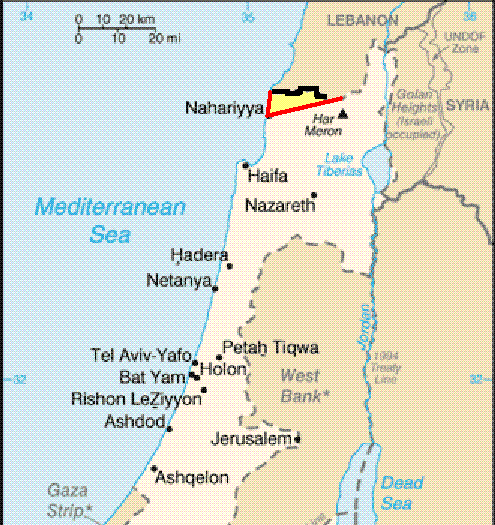
Israeli city tops mesothelioma occurance

Nahariya, a city on the north coast of Israel, has a surprisingly high rate of mesothelioma cancer.

According to the Israeli Health MinistryĆ¢€™s cancer registry, approximately 5.72 per 100,000 residents have the asbestos-related disease, making it one of the highest rates in the world.

Unfortunately, this number is expected to keep rising due to the extremely long latency period of mesothelioma. If it does, it could overtake Genoa, Italy which currently has a mesothelioma rate of about 5.8 out of 100,000.

The asbestos plant that was located in Nahariya was the only one in Israel and closed in 1997. There were more than 600 reported cases of mesothelioma diagnosed in Israel between 1990 and 2008, with approximately 30 new cases a year.

Mesothelioma has been linked to asbestos exposure, the only way known to contract the rare and usually fatal cancer.

Asbestos compensation ruling upheld

Workers who were exposed to asbestos at the Riegel Paper Mills in New Jersey will be awarded their previous monetary compensation as a result of a ruling by the New Jersey state court.

The original trial, held in the Civil Division of Superior Court in New Brunswick, dragged on for 6 weeks. The following rulings for compensation were issued: Walter L. Patton, $514,220; the estate of Harry H. Wilson, $76,102; and the estate of Walter W. Grube, $259,045.

The defendant, Scapa Dryer Fabrics, Inc., a manufacturer of the felts that dried the wet rolls of paper on the mill’s paper machines, argued that the rulings for compensation were too large and appealed the awards, claiming that the jury had failed to account for the liability to the other defendants due to some errors in the trial. The appeal was dismissed on the grounds that it was “without merit.”

The dryer felts that the men worked with contained asbestos, the dangerous mineral that can cause mesothelioma. Despite the fact that Scapa knew asbestos could be released from the felts, the company failed to place warning labels on them, and the men were never instructed to take any specific precautions related to asbestos around the machines.

Jury awards $700,000 to mesothelioma victim

The family of Tom Firth, a 72-year old South Carolina resident who suffered from mesothelioma caused by asbestos exposure, was awarded $700,000 as a result of a verdict against Garlock Sealing Technology, LLC.

Firth’s only known asbestos exposure happened at Bethlehem Steel, Sparrows Point, in the 1950s, where he worked for less than a year. As a mechanic’s assistant on a battery of coke ovens, he worked with Garlock gaskets and packing on the pumps and valves associated with the coke ovens.

“While Garlock has admitted outside of the courtroom that their products can cause cancer, they refuse to do so in the courtroom. It was satisfying to hear the jury unanimously find that Garlock’s asbestos products were dangerous and that Garlock is responsible for this terrible loss to the Firth family,” said Chris Panatier, lead counsel for the Firth family.

Last remaining W.R. Grace defendant has charges dismissed

According to a notice filed in the U.S. District Court in Missoula, federal prosecutors have dismissed charges against the only remaining defendant in the criminal case of W.R. Grace & Co.

Last month, Grace and three individual defendants were acquitted on charges relating to a criminal conspiracy involving Clean Air Act violations and obstruction of justice. A fourth defendant, O. Mario Favorito, was removed from the case due to potential conflicts with his defense. He was slated to stand trial separately in September, but his case was dismissed on May 8, 2009.

The case against Grace began in 2005 when a federal grand jury handed down an unprecedented indictment, alleging a 30-year conspiracy to defraud the government and knowingly endanger the residents of Libby, Missouri. While seven Grace employees were initially named in the indictment, charges were dropped at the request of the prosecutors, who conceded they lacked the evidence needed to convict the men.

A mortality study at the Center for Asbestos Related Disease in Libby has found 227 community members died from the asbestos diseases like mesothelioma cancer, and lists more than 1,800 active cases resulting from exposure to the deadly mineral. The study also relates scores of deaths to non-occupational asbestos-exposures, and finds that 77 people who never worked at GraceĆ¢€™s mine in Libby have died of asbestos disease since 1998.

Related Posts with Thumbnails

Subscribe

Enter your email address:

Delivered by FeedBurner

All Posts

 
Health Blogs - BlogCatalog Blog Directory Yellow Pages for USA and Canada